

Finding the why is the easy part of strategy. The hard part is making sure it leads somewhere, especially when results are still acceptable and nobody feels the urgency. At Libertel the why was already part of the culture before the model existed. In another project the initiative died because management refused to embrace the discomfort.
Strategy starts with ‘why’
And that’s harder than it sounds
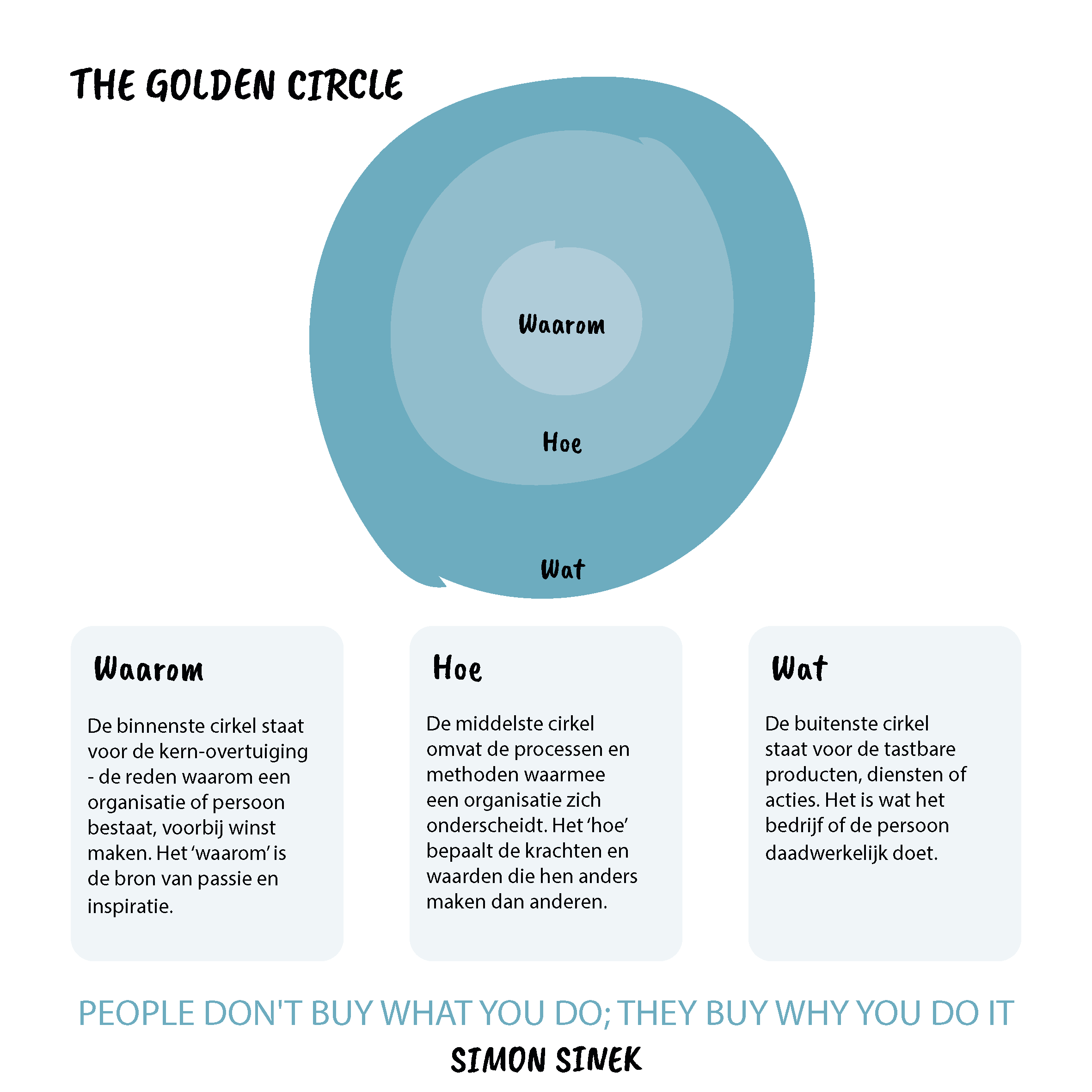
You probably know Simon Sinek’s TED Talk as well as I do. “People don’t buy what you do, they buy why you do it.” I’ve used it in presentations, quoted it in sales training, and shown it to clients as a way into a conversation about positioning. The model is elegant, it makes immediate sense, and almost everyone nods when you explain it.
But there’s something Sinek doesn’t show you in those 18 minutes. How you actually apply it inside an organisation that has worked the same way for 10, 15, 20 years. And what happens when management doesn’t feel the urgency, even while everyone around them can see something has to change.
I’ve watched that up close twice. Once it went well. The other time, less so.
Libertel knew it, before the model existed
In 1998 I joined Libertel, the second mobile operator in the Netherlands, the company that would later become Vodafone. When Libertel started in 1995, mobile penetration in the Netherlands was below 2%. Making a mobile call was expensive, awkward, and for most people at that point simply not relevant.
And still we believed in it completely. We had almost no figures to justify that. What we had was a conviction: mobile telephony should be within reach of everyone, not only the business early adopter or the director with the big car. That was our why, long before Sinek gave it the word.
That conviction drove everything. Our first slogan, “Everyone reachable, reachable for everyone”, was a direct translation of what we stood for. The launch of Libertel iZi in 1997, the first prepaid offer in the Netherlands, followed logically from one question: how do we make this available to people who don’t want a contract, or can’t get one? Calling without a subscription. Simple idea, big impact.
The result: from 26,000 subscribers at the end of 1995 to 1 million in 1998. 15 years after it was founded, Vodafone Netherlands was the country’s second telecoms provider, with 4.7 million customers and 2,800 employees.
Looking back, you can map that onto Sinek’s model. Our why was reachability for everyone. The how was national coverage, prepaid, and campaigns that spoke to ordinary people and he what was the SIM cards, the contracts and the handsets. In practice we never thought in that order. We just did it, driven by that one shared conviction.
As the manager of communications for the business market, I noticed it in my daily work. Commercials, trade fairs, seminars, customer loyalty programmes: once the direction is clear, communication questions answer themselves. And they get a lot more interesting.
Build the company first, then look for the why
At Libertel it worked because the why was there before the organisation was. It sat in the people who chose to join, in the products we developed, in the campaigns we made. It never had to be defined afterwards, only applied consistently
But what if you try it the other way round? Build the company first, and go looking for the why at a later stage? I’ve seen that as well.
A few years ago I worked on a project at an organisation standing at a crossroads. They wanted to position themselves differently: more relevant, closer to the customer, further away from the commodity trap they’d slowly walked into. Management had decided it had to change. So far, so good.
We put together a working group with people from across the whole organisation. The brief was clear: start with the why. What drives us? Why does this company exist, revenue aside?
What happened next was predictable, and it was no less frustrating to watch for that. Within 20 minutes the conversation slid down to the what. What do we do now? Are we good at it? What is the competition doing? And then the how: how do we tackle that, how do we organise it, how do we communicate it to the market?
The why never got answered. People weren’t unwilling. It’s just uncomfortable. It asks for honesty about what you actually want to mean to someone, and that stings when your daily practice has drifted from it for years.
After a few sessions we did get somewhere. We articulated something that rang true: this wasn’t about products or contracts, it was about helping customers grow with confidence. That was the real driver, even though nobody had ever put it into words. There was energy in the room. The feeling that we’d found something worth having.
The trap Sinek doesn’t name
In the end, management didn’t see enough value in it. Not because they failed to understand the model. Because the company had been functioning a certain way for years, and that way worked, at least in the short term. There were targets, there were customers, there was a pipeline.
“Why turn everything upside down for an abstract question like why we exist?”
That was the unspoken question. And that’s exactly the problem: the Golden Circle works best when you’re willing to sit with the discomfort before it’s too late.
The initiative died quietly. Our working group was dissolved, the insights ended up in a presentation nobody opened again, and the company carried on the way it had for years.
What I do with it in my own work
After a project like that you look at the Golden Circle differently. As a model, and also as a photograph of an organisation’s culture: what actually matters there, as opposed to what gets said.
Rather than walking organisations through a workshop where they formulate their why, I try to have the conversation about what they want to mean to their customers. As an ordinary question in an ordinary conversation. Why do you approach this the way you do? What makes you interesting to this particular customer? Why would someone choose you over the competition?
Those questions look simple. But the answers, if you take the time to really ask them, tell you more about an organisation than any strategy document. And they make it clear quickly whether there’s someone at the top willing to do something with it.
Because that’s the lesson I take from both experiences. Finding the why is the easy part. The hard part is making sure it leads somewhere afterwards.
So next time you’re in a strategy meeting and someone says “We need to find our why!”, don’t only ask “What is our why?”. Ask straight after: “Who’s prepared to fight for it when it gets uncomfortable?”
That’s the difference between a nice model and a model that changes something.