

Where BANT comes from
BANT is the oldest of the 3, developed by sales teams at IBM. Budget, Authority, Need, Timing: 4 questions you want answered in a first conversation. Has the customer set money aside? Am I talking to someone who can decide? Is there a real need? And when does this have to be solved?
I recognise those questions from my first years in sales, at Libertel, before it became Vodafone. The cycle was short and the deal was simple: a contract, a signature, done. BANT fitted exactly, even though nobody called it that at the time. 4 questions, answered in a few minutes, and you knew whether a lead was worth pursuing.
BANT is still useful for precisely that work: the first sieve, usually at an SDR, before a lead reaches an account manager. The problem starts when you use BANT on a deal that looks nothing like it.
Why 4 questions aren’t enough
An enterprise deal with a 6-month cycle, 6 stakeholders and a competitor you never see but definitely feel is not a BANT deal. Budget usually exists somewhere, spread across 3 departments. Authority often sits with a committee you never get in a room together. And “need” tells you nothing about whether that need sits high enough on the priority list to get action this quarter.
I’ve watched account managers forecast a deal on BANT while the real reason it stalled lay somewhere else entirely: a champion without influence, or a procurement process nobody had mapped. BANT had all 4 boxes ticked. The deal still didn’t close, because we thought we knew everything.
MEDDIC: the 6 questions that take a deal apart
MEDDIC came out of Parametric Technology Corporation in the early 1990s, devised by Jack Napoli and Dick Dunkel, for exactly this kind of deal. Metrics, Economic Buyer, Decision Criteria, Decision Process, Identify Pain, Champion.
Metrics forces you to name what the customer concretely gains, in time or money, rather than vague terms like “more efficient”. Economic Buyer is the person with budget responsibility, and that’s almost never the same person as your champion. Decision Criteria and Decision Process expose how the customer decides internally and against which criteria, something you rarely hear at a first meeting. Identify Pain asks about the problem that’s big enough to act on now, rather than one day. And Champion is the person inside the customer who argues for you when you’re not in the room.
That distinction between champion and economic buyer is where most lost deals come apart, in my experience. An enthusiastic champion feels like progress. Without access to the economic buyer, that same champion is usually a dead end, however warm the conversation feels.
The P and the second C
MEDDPICC adds 2 letters to MEDDIC: **P**aper Process and **C**ompetition. In cybersecurity, where I’ve spent most of my career, these are often the 2 that make or break a deal, more so than the other 6.
Paper Process is everything that happens after the customer has said yes internally: legal review, procurement, and with a security product almost always a security assessment of your own product. I’ve watched a deal sit still for 3 months because nobody had asked how long the customer’s own security review takes. The customer wanted the product. The paperwork had its own agenda.
Competition goes further than “who is the competitor?”. It’s about knowing whether there is a competitor in play at all. A deal that looks competition-free usually just has a competitor you haven’t found yet. A customer who says “We’re not comparing, we’re only talking to you” is looking at his options as well. He simply isn’t telling you, which leaves you comfortable on no evidence and working in the dark.
A sales manager with good instincts for a room has learned to see what’s happening in it.
What a sales director actually gains
This is where it comes together. The point of MEDDIC or MEDDPICC is the shared language it gives a team, which makes “promising” from 3 different account managers comparable for the first time.
When every deal in the pipeline answers the same 8 questions, you see at a glance where each one really stands, regardless of how many are on the list. A deal with no identified economic buyer stands differently from one where that relationship exists, whatever the account manager says about it. You see that difference in the data now, rather than after the deal is lost.
It also gives you a view of your people. An account manager whose “80%” deals structurally lack an economic buyer or a champion is more optimistic than his pipeline justifies. That’s a coaching question: where in the conversation is he missing the step that gets him to the right person? Compare that with a colleague whose forecast is right time after time, and you know immediately who to sit down with, and why.
At team level it works the same way. 2 regions can have exactly the same pipeline size and carry a completely different risk, if one of them scores structurally weaker on decision process or paper process. You won’t see that in a revenue figure. You see it once you put every deal through the same 8 questions.
The risk of a checklist
There’s a catch, and I’ve watched it go wrong myself. MEDDPICC only becomes worth something when it’s part of the customer conversation itself, rather than a form an account manager fills in afterwards to satisfy a CRM requirement.
I’ve seen teams where every field was neatly completed, and where the deal was still lost because nobody had actually asked the customer those questions. The account manager had invented the answers, or assumed them, to get past the stage gate. A completed checklist with no real conversation behind it is more dangerous than an empty one, because it creates confidence with nothing underneath.
The questions are only useful when you ask them out loud, to the customer, in the conversation, and record the answers as they are. Including when that makes a deal look worse than it did last week.
In black and white
This stays hard to grasp in the abstract, so here’s one example per method, filled in the way it looks after a real conversation. First BANT, on a simple deal: a construction firm that wants to bundle its mobile contracts.
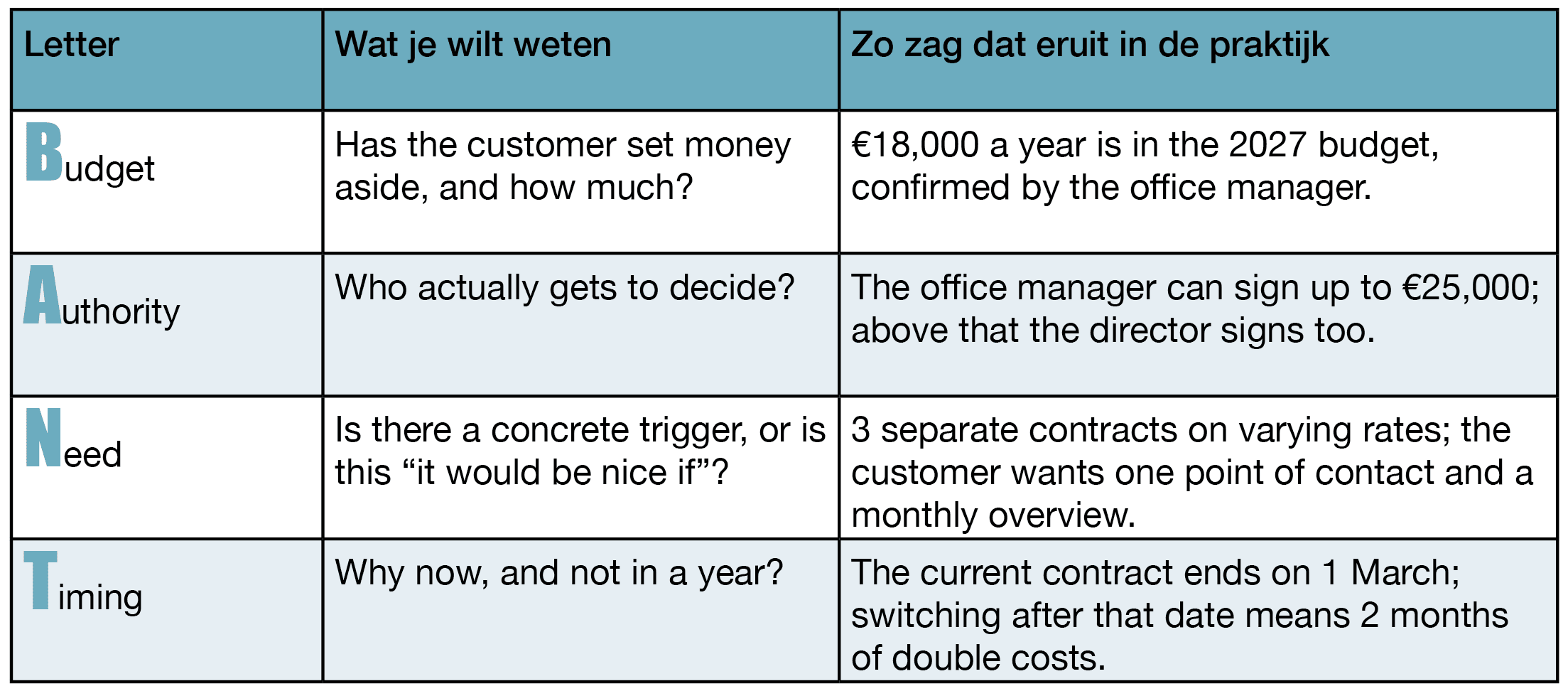
Read the BANT qualification in English
| Letter | What you want to know | How that looked in practice |
|---|---|---|
| B Budget | Has the customer set money aside, and how much? | €18,000 a year is in the 2027 budget, confirmed by the office manager. |
| A Authority | Who actually gets to decide? | The office manager can sign up to €25,000; above that the director signs too. |
| N Need | Is there a concrete trigger, or is this “it would be nice if”? | 3 separate contracts on varying rates; the customer wants one point of contact and a monthly overview. |
| T Timing | Why now, and not in a year? | The current contract ends on 1 March; switching after that date means 2 months of double costs. |
For the more complex deals, like the security deals at CounterCraft, BANT is too coarse. We did use it, as a first qualification. Once you knew the answers to BANT, the opportunity could go into your forecast and earned a place in the CRM. Before that, a “promising” deal didn’t get discussed in the Monday forecast call at all.
Below is a security deal worked out across 8 questions. The first 6 are MEDDIC; Paper Process and the second C for Competition are what MEDDPICC adds.
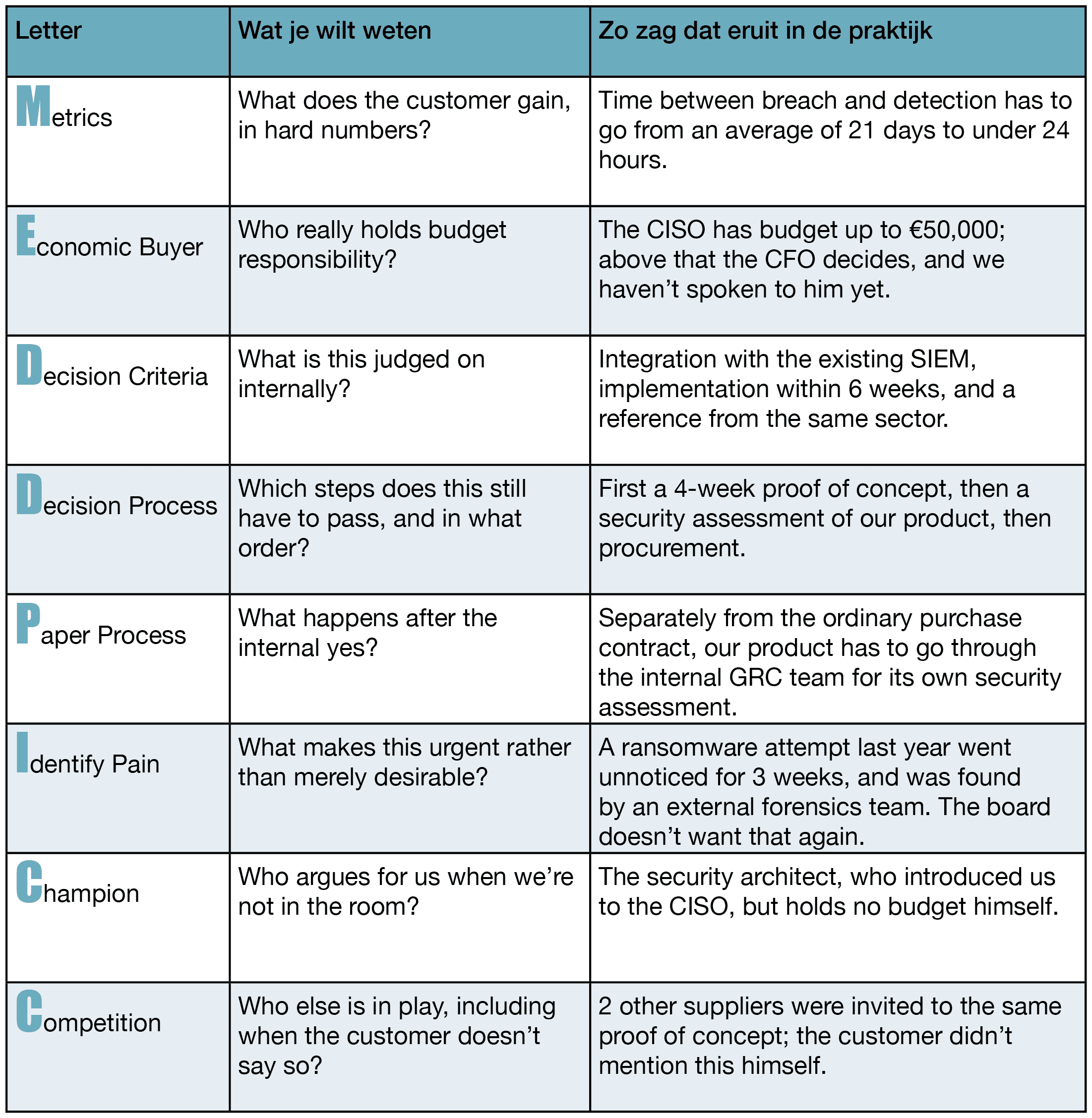
Read the MEDDPICC qualification in English
| Letter | What you want to know | How that looked in practice |
|---|---|---|
| M Metrics | What does the customer gain, in hard numbers? | Time between breach and detection has to go from an average of 21 days to under 24 hours. |
| E Economic Buyer | Who really holds budget responsibility | The CISO has budget up to €50,000; above that the CFO decides, and we haven’t spoken to him yet. |
| D Decision Criteria | What is this judged on internally? | Integration with the existing SIEM, implementation within 6 weeks, and a reference from the same sector. |
| D Decision Process | Which steps does this still have to pass, and in what order? | First a 4-week proof of concept, then a security assessment of our product, then procurement. |
| I Identify Pain | What makes this urgent rather than merely desirable? | A ransomware attempt last year went unnoticed for 3 weeks, and was found by an external forensics team. The board doesn’t want that again. |
| C Champion | Who argues for us when we’re not in the room? | The security architect, who introduced us to the CISO, but holds no budget himself. |
| P Paper Process | What happens after the internal yes? | Separately from the ordinary purchase contract, our product has to go through the internal GRC team for its own security assessment. |
| C Competition | Who else is in play, including when the customer doesn’t say so? | 2 other suppliers were invited to the same proof of concept; the customer didn’t mention this himself |
Note the order in which this came out. It isn’t necessarily the order of the letters in the name. Identify pain and champion you usually have after the first conversations. Getting a proper view of the economic buyer often takes extra work. So do the metrics, which are usually more than a single figure. And the paper process, in this case CounterCraft’s own product security assessment, only turned out to exist in the very last phase, once we asked about it explicitly. So never fill in a table like this in one go, upfront. Let it grow through the conversations with your prospect.
Back to Monday
We brought MEDDPICC into CounterCraft after that one forecast call with 3 versions of 80%, as questions we asked literally in every customer conversation from then on, rather than a field somebody completed in the CRM afterwards. Within a quarter the Monday conversation changed. No longer “what’s your feeling about this deal”, but “who is the economic buyer? Have you spoken to him yourself? What motivates him and who does he report to?”
The deal with the enthusiastic champion and no access to budget turned out to be the weakest of the 3. We knew that after one conversation, instead of after a lost quarter. The deal with the unclear security process did close in the end, 2 months later than forecast, which is exactly as long as that review took once we asked about the process.
Neither outcome was a surprise. That’s the whole point. A pipeline that stops surprising you is a pipeline you can steer.
Further reading
If you want to go deeper, there are 2 books I keep on my own shelf:
- MEDDICC: The Ultimate Guide to Staying One Step Ahead in the Complex Sale (Meddicc Ltd, 2020) by Andy Whyte
- Always Be Qualifying: M.E.D.D.I.C. – MEDDPICC® (01consulting, 2020) by Darius Lahoutifard
Both are treated internationally as the reference for the method, and they’re worth well over what they cost. I recommend them both.
Want to help your sales managers develop this skill? Have a look at what Training and coaching from Uphill Sales can do, or get in touch.