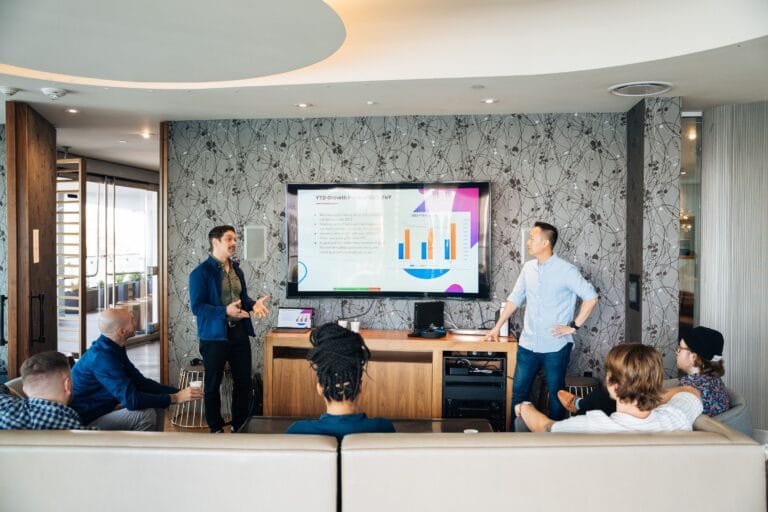

Remote work didn’t make sales management harder. It made visible which sales managers were leaning on things they could no longer rely on once the environment changed. The shift from office intuition to reading signals asks for leaders who can do something different: read signals instead of rooms.
Why remote sales teams need different leaders
I once coached a sales manager, let’s call him Arnold, who was hard to miss in the office. He walked around, spoke to people, picked up the mood. If someone had just had a difficult conversation with a customer, he knew before anyone came to tell him. If a deal started to stall, he felt it in the way his rep talked about the weekend.
He was good. Really good. His team performed, his people were loyal, his pipeline held up.
When the office closed during the pandemic, something changed. The first few weeks everything seemed to carry on. After a month or two he had the feeling he was losing his grip. He asked me to help him. He no longer knew what was going on. The antennae that had never let him down had stopped working.
He missed things. His team was telling him plenty. The problem was that he was used to picking up information without anyone telling him. He read the room. And the room was gone.
What office management actually was
What he did has a name, though he never used it himself: management by walking around. You walk past desks, you catch half a conversation, you see who leans back in frustration and who is animated on the phone. You build a picture of the state of your team without anyone briefing you on it.
That picture was worth having. It was also completely dependent on physical proximity. The skill sat in the environment as much as in the manager. The office did part of the work.
The moment that environment fell away, the information sources fell away with it. What remained were the formal channels: the weekly update, the one-to-one, the CRM note. Information that has been filtered, delayed and framed by the person passing it on. That is a different thing entirely from information you pick up yourself.
The misunderstanding about remote management
In the years after the pandemic, hundreds of articles appeared about remote leadership. Most of them are about tools, rhythms and rituals. Use video more than chat. Schedule fixed check-ins. Be more explicit in your communication. Useful advice. It is also advice about transporting office management into an online environment. It assumes the core skills stay the same and that all you have to adjust is the infrastructure.
In my view that is a large misunderstanding.
Remote work management asks for a different skill in a different setting. That skill has to do with reading signals rather than reading rooms.
A sales manager who is good at office intuition has learned to see what happens in a room. A sales manager who is good at reading signals has learned to see what happens in a pattern. The first is direct and almost physical: you see someone, you hear something, you feel a mood. The second is indirect and analytical: you notice that someone speaks up less in shared meetings, that his pipeline hasn’t been updated for three weeks, that he no longer mentions a customer who was a priority two months ago.
Remote work removes the direct layer and leaves the signals in place. For managers who are used to leaning on that direct layer, that is a problem. For managers who have always navigated on signals, less changes than you would expect.
What I have seen work
The sales managers I have seen do best in remote and hybrid environments have a few things in common. Not all of them, not always, but often enough that it can’t be coincidence.
They are sparing with meetings and present when it matters. They don’t book a weekly hour per team member to walk through the agenda but open a conversation the moment they have seen something that occupies them. A pattern in the activity, an unusual silence, a subtle change in tone.
They ask questions that leave room. “What’s on your mind at the moment?” rather than “is everything alright?” “What would help you most on that deal?” rather than “how is that deal going?” The first kind asks for reassurance. The second asks for openness.
They read the CRM as behavioural data, not only as a reporting tool. They see what gets filled in, and also what doesn’t. Finally they notice when someone keeps everything tidy and never adds anything unprompted.
They build trust outside the formal channels. Not through a virtual team outing once a quarter, but through small, consistent moments. A message on a Tuesday with no agenda behind it. The recognition that doesn’t wait for the team meeting.
The manager who struggled
Back to Arnold. His story has no dramatic ending. He wasn’t fired, his team didn’t fall apart. There was a period of a year or 18 months where his results sat below what they had been. The pandemic played a part in that, and it wasn’t the only cause. It hurt, because he wasn’t used to it, and even more because he didn’t understand it.
What he eventually learned had little to do with improving his management style. It was about widening his sources of information. He learned to look deliberately at behaviour he used to pick up without noticing. He learned to ask questions he had never needed before, because the room already gave him the answer.
It took him time. The interesting part: he didn’t come out of it better than he was before. He came out different. And in the hybrid environment his team works in now, different is exactly what is needed.
Different, rather than better
The title of this article contains a deliberate choice: remote sales teams ask for different leaders, not better ones. That distinction goes beyond semantics.
Better suggests a scale on which one manager scores higher than another. The shift to remote and hybrid work is a change of context rather than a test of quality. There are excellent sales managers who perform exceptionally in an office and struggle remotely. Their skills are tied to a context that suddenly isn’t there any more. The reverse exists too: managers who were less visible in the office and thrive remotely, because the way they communicate and pick up signals fits what remote work asks for.
What most organisations do is train the office manager to become remote. That works sometimes. And sometimes “who fits the context we have now?” is a more interesting question than “how do we adapt this manager to a context that doesn’t suit him?”
That is an uncomfortable thought, certainly for a manager who built his whole career in an office. It is also an honest one.
What this means for sales organisations
The discussion about remote work in sales organisations is almost always about the productivity of the reps. That question makes sense. It also skips a subtler shift: the one in the sales manager.
If your reps work remotely, so does their manager. Whether that manager can handle it is rarely the first question anyone asks. The assumption is that a good sales manager is a good sales manager, whatever the environment. My observation, after years of working with sales teams in different contexts, is that the assumption doesn’t always hold. Context matters too. The skills that count differ. And whoever recognises that has an advantage in building, developing and assessing their sales leadership.
Arnold still walks around the office. His team is at home three days a week. He has learned that walking around on its own is no longer enough. He used to read the room. Now he reads signals. Those are two different skills, and he had one of them. The good news is that the second can be learned. You do have to choose it. Arnold chose, and learned, and stayed himself while doing it.
Want to develop this in your own managers?
This is exactly what I work on in training and coaching: coaching behaviour that holds up when the room isn’t there to help. Get in touch if you want to look at where your team is losing deals.